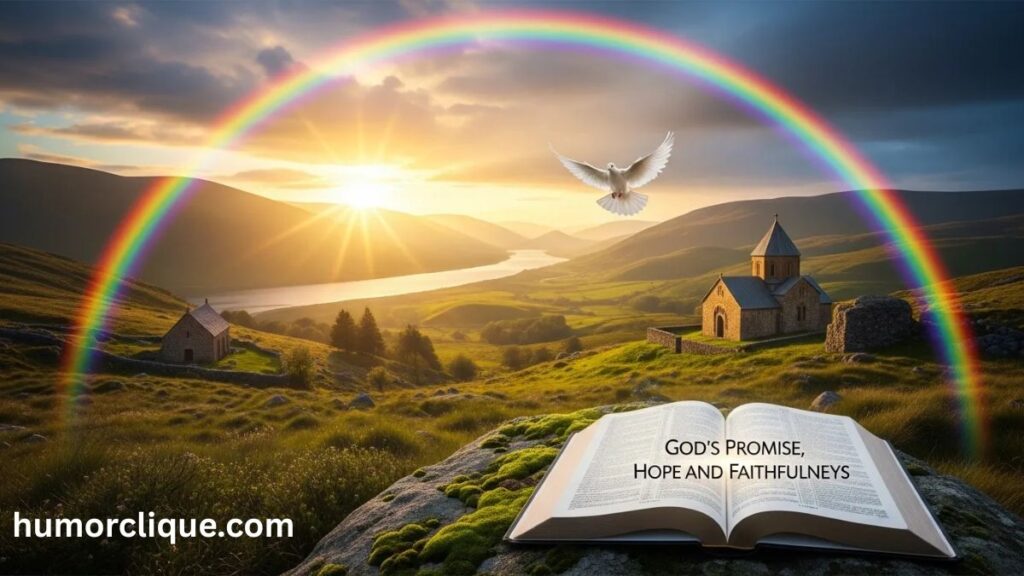
Few sights stop people in their tracks quite like a rainbow. Something about those arching bands of color makes even the most distracted person look up and pause. But if you’ve ever wondered whether that moment carries deeper significance — you’re asking exactly the right question.
The rainbow meaning in the Bible goes far beyond meteorology. It’s a covenant sign, a declaration of divine character, and a thread that runs from the first pages of Genesis all the way to the heavenly throne room in Revelation. This isn’t a children’s Sunday school symbol. It’s one of the most theologically loaded images in all of Scripture.
Let’s unpack it — layer by layer.
What the Rainbow Really Means in the Bible — And Why It Still Matters Today
Most people treat the rainbow as a pleasant afterthought following rain. The Bible treats it as a legal instrument between God and all of creation.
That distinction matters enormously. When you understand what God was actually doing in Genesis 9, the rainbow stops being a pretty backdrop and becomes one of the most astonishing expressions of God’s faithfulness ever recorded. It’s a sign God set in the sky not for your benefit primarily — but for His own. He looks at it and remembers His promise.
That’s the kind of God the Bible introduces you to. And understanding the biblical meaning of rainbow reshapes how you see every single one.
The Rainbow’s Origin in Scripture — Genesis and the Noahic Covenant
The Flood, the Ark, and What Came After
To understand the rainbow in the Bible, you have to start at Genesis 6–9 — one of the most sobering passages in all of Scripture. God observed the complete moral corruption of humanity and determined to judge the earth through a worldwide flood. Noah, described as “a righteous man, blameless in his generation” (Genesis 6:9), was instructed to build Noah’s Ark and preserve his family along with representatives of every living creature.
The flood lasted 40 days and 40 nights. The waters prevailed on the earth for 150 days. When the waters finally receded and Noah stepped off the ark, he built an altar and offered burnt offerings to God.
Then God did something remarkable.
He made a promise. And He made it visible.
“I have set my bow in the cloud, and it shall be a sign of the covenant between me and the earth.” — Genesis 9:13 (ESV)
Notice what God said: “I have set my bow.” This was a deliberate, sovereign act. God placed the rainbow in the sky as a covenant sign — not as a reward for good behavior, but as a binding declaration of His own character.
The Hebrew Word Qeshet — This Changes Everything
Here’s something most articles completely miss: the Hebrew word translated “rainbow” in Genesis 9 is qeshet (קֶשֶׁת). That word doesn’t primarily mean “rainbow.” It means bow — as in a warrior’s bow. A weapon.
Think about what that communicates. In the ancient Near Eastern world, when a warrior hung up his bow after battle, it signaled that hostilities had ceased. By placing His qeshet in the clouds, God was symbolically hanging up His war bow. He was communicating: the judgment is finished. I am at peace with the earth.
Theologian Sinclair Ferguson describes this as one of the most powerful expressions of divine restraint in all of Scripture — God visibly laying down the instrument of His wrath.
The Noahic Covenant — What Kind of Promise Was This?
The Noahic Covenant stands apart from every other biblical covenant in one crucial way: it’s entirely unconditional.
God didn’t say “I will never flood the earth again if you obey Me.” He simply said He will not. Full stop. No conditions attached. No performance required from humanity’s side.
This makes it different from, say, the Mosaic Covenant (which was conditional on Israel’s obedience) or even aspects of the Abrahamic Covenant. The covenant with Noah is entirely on God’s shoulders. He made the promise unilaterally. He’ll keep it unilaterally.
And notice the scope. Genesis 9:12–13 makes clear this covenant wasn’t just for Noah, his family, or even humanity:
“This is the sign of the covenant that I make between me and you and every living creature that is with you, for all future generations.”
Every living creature. God entered into a covenant relationship with animals, birds, and every living thing. The rainbow covenant has a cosmic, ecological dimension that most sermons never touch.
Key Bible Verses About the Rainbow — In Context
| Verse | Book | Core Meaning |
| Genesis 9:13–16 | Old Testament | The rainbow as covenant sign — God’s promise never to destroy the earth by flood again |
| Ezekiel 1:28 | Old Testament | Rainbow surrounding God’s glory in Ezekiel’s vision of the divine chariot |
| Revelation 4:3 | New Testament | Emerald rainbow encircling God’s throne in Apostle John’s heavenly vision |
| Revelation 10:1 | New Testament | A mighty angel with a rainbow over his head — carrying God’s covenant authority |
Each of these appearances builds on the others. Together, they form a complete theological picture of what the rainbow symbolism communicates across the whole of Scripture.
Spiritual Symbolism of the Rainbow in the Bible — Layer by Layer
“The rainbow is God’s autograph written across the sky.” — Anonymous
The biblical symbolism of rainbow isn’t a single note. It’s a chord — multiple meanings resonating simultaneously. Here are the five major layers.
Symbol of God’s Absolute Faithfulness
Genesis 9:15 records God saying: “I will remember my covenant.” That phrase deserves more attention than it usually gets.
God doesn’t forget things. His declaration that He “will remember” isn’t admitting the possibility of forgetfulness — it’s a covenantal formula. In ancient Near Eastern cultures, to “remember” a covenant was to act in accordance with it. God is saying: I will always act according to this promise.
God’s faithfulness isn’t a mood. It’s not contingent on your circumstances being favorable. The Noahic Covenant proves that God’s promises don’t expire, don’t depreciate, and don’t require your cooperation to remain valid.
That matters enormously when your life looks nothing like God’s promises seem to guarantee. The rainbow still arches. The promise still stands.
Symbol of Hope Forged in Judgment
Here’s something theologically striking: the rainbow after the storm doesn’t erase the flood. It follows
The rainbow doesn’t pretend the judgment didn’t happen. It appears in the aftermath of the most catastrophic event in human history. Grace and holiness don’t cancel each other out in Scripture — they coexist in creative tension. God’s mercy doesn’t negate God’s justice. The flood happened because God is holy. The rainbow appeared because God is merciful.
This is hope after hardship — not cheap optimism that ignores pain, but something forged in the fire of real judgment and real grace meeting at the same point in history.
If you’re walking through your own flood season right now, that’s worth sitting with.
Symbol of God’s Shekinah Glory
The rainbow in the Bible doesn’t stay in Genesis. It reappears in Ezekiel 1:28 in an entirely different context:
“Like the appearance of a rainbow in the clouds on a rainy day, so was the radiance around him. This was the appearance of the likeness of the glory of the Lord.”
Ezekiel’s vision of God’s glory — the famous “chariot vision” or merkabah — is one of the most intense theophanies (divine appearances) in all of Scripture. Four living creatures, wheels within wheels, fire and lightning — and surrounding the entire vision, like a border, is the appearance of a rainbow.
The rainbow here isn’t a promise sign. It’s a glory boundary — the outermost visible edge of God’s holiness. It marks where divine presence is so concentrated that it becomes visible.
John Gill, the eighteenth-century Baptist theologian, noted in his commentary that the rainbow in Ezekiel functions as a kind of veil — God’s glory is so infinite that even the rainbow which surrounds it is merely a likeness of that glory, not the thing itself.
Symbol of Cosmic Reconciliation
The scope of the Noahic Covenant is breathtaking. It’s not a personal promise to Noah or a national promise to Israel. It’s a cosmic promise — God reconciling Himself to all living creatures on earth.
The Apostle Peter later connected the flood narrative directly to baptism and to God’s covenant mercy operating across redemptive history (1 Peter 3:20–21). The flood becomes a type — a shadow — pointing forward to Christ, through whom God achieves the ultimate cosmic reconciliation, reuniting all things under His headship (Ephesians 1:10).
The rainbow, then, points forward. It’s a preview of Revelation 21–22, where the New Creation emerges and God makes “all things new.”
Symbol of New Beginnings After Desolation
Every major new beginning in Scripture follows a death or a judgment. Noah steps off the ark into a world washed clean. Israel emerges from the Red Sea after Egyptian bondage. Christ rises after the cross.
The rainbow after rain embodies this rhythm. Something had to end — violently, completely — before the new thing could begin. The rainbow symbolism here is less about comfort and more about transformation. What God resets, He doesn’t just restore to what it was. He moves it forward.
What Do the Individual Colors of the Rainbow Mean Biblically?
Here’s an honest answer most articles won’t give you: Scripture doesn’t assign specific theological meanings to each individual color of the rainbow. Anyone claiming to give you a precise per-color breakdown is going beyond what the Bible actually says.
However, Scripture does use colors symbolically elsewhere. Here’s what the broader biblical context suggests:
| Color | Biblical Symbolism Across Scripture | Reference |
| Red | Blood, atonement, sacrifice | Leviticus 17:11; Isaiah 1:18 |
| Orange/Yellow | Fire, divine presence, refinement | Exodus 3:2; Malachi 3:2 |
| Green | Life, renewal, flourishing | Psalm 23:2; Revelation 22:2 |
| Blue | Heaven, divine law, priestly calling | Numbers 15:38; Exodus 26:4 |
| Purple | Royalty, priesthood, majesty | Esther 8:15; John 19:2 |
| White | Purity, holiness, victory | Revelation 3:5; Daniel 7:9 |
| Gold | Divine glory, eternal value | Revelation 21:18 |
These biblical rainbow colors carry symbolic weight individually across Scripture — but the rainbow as a unit is treated as a single covenant sign, not a seven-part coded message.
The Rainbow in Prophecy and Apocalyptic Literature — What Revelation Reveals
The rainbow in heaven appears three times after Genesis. Each appearance deepens the theological meaning.
Revelation 4:3 — The Rainbow Around God’s Throne
Revelation 4:1–3 records one of the most awe-inspiring visions in all of Scripture:
“And he who sat there had the appearance of jasper and carnelian, and around the throne was a rainbow that had the appearance of an emerald.”
Let that sink in. At the very center of God’s throne room — the seat of ultimate cosmic justice, where all final judgments are decided — there is a rainbow around God’s throne.
Why does this matter? Because when Apostle John wrote Revelation, his readers would have known exactly what that rainbow meant. It was the covenant sign from Genesis 9. God, sitting in the seat of ultimate judgment, is surrounded by His own covenant mercy.
The emerald rainbow — intensely green — communicates life, renewal, and flourishing. Even at the moment of final judgment, mercy encircles the Judge.
Sinclair Ferguson wrote that this image should permanently reshape how Christians approach God. We don’t come to a throne stripped of mercy. We come to a throne adorned with it.
Revelation 10:1 — The Angel Crowned With a Rainbow
“Then I saw another mighty angel coming down from heaven, wrapped in a cloud, with a rainbow over his head, and his face was like the sun, and his legs like pillars of fire.”
This angel with a rainbow arrives carrying a little scroll — and his presence signals a major prophetic declaration about the completion of God’s mystery (Revelation 10:7).
The rainbow on his head communicates that this angel comes as God’s authorized representative, operating under the protection and authority of God’s covenant. He doesn’t arrive in naked divine wrath. He comes wrapped in the sign of covenant mercy.
Ezekiel’s Rainbow — The Prophet Who Saw Glory
Ezekiel 1:4–28 deserves far more attention than it typically receives in discussions of the rainbow spiritual significance. The prophet described wheels within wheels, living creatures with four faces each, and a vast expanse like “an awesome crystal” — and above it all, the figure of the Lord, surrounded by radiance “like the appearance of a rainbow in the clouds.”
This is a theophany of the highest order. And the outermost visible boundary of God’s glory — the thing that frames and contains the entire vision — is the rainbow.
The rainbow and God’s glory are inseparable in Ezekiel’s vision. God’s holiness is so intense it becomes visual. The rainbow doesn’t just point to God — it borders Him.
What Does It Mean to See a Rainbow — In Real Life or in a Dream?
Seeing a Rainbow in Real Life — Spiritual Discernment, Not Superstition
When you see a rainbow after rain, does it mean God is sending you a personal message? Honestly — not necessarily. But that doesn’t mean the moment is theologically empty either.
Here’s the distinction worth drawing carefully:
- Sign theology says: God has assigned specific meaning to this symbol in Scripture; seeing it can rightly prompt Scripture-grounded reflection
- Superstition says: this particular rainbow, right now, is a direct omen about my specific situation
The Bible doesn’t give you permission for the second. It absolutely supports the first. The visible sign of God in the sky is always pointing back to Genesis 9 — the same covenant with Noah, the same God’s faithfulness, the same rainbow and God’s promises that have stood for thousands of years.
So when you see one, the right response isn’t “What is God telling me specifically right now?” The right response is “God keeps His word.” Let it trigger prayer and gratitude, not fortune-telling.
Rainbow Symbolism in Biblical Dreams
Biblical dream interpretation requires care. God did communicate through dreams in Scripture — to Joseph (Genesis 37), to Daniel, to the magi in Matthew 2, and to Joseph, Jesus’ earthly father, in Matthew 1. Dreams played a significant role in biblical prophecy.
But here’s the critical framework Scripture itself provides for evaluating any dream:
- Does the content align with Scripture? If it contradicts biblical truth, it isn’t from God — regardless of how vivid it felt.
- Does it produce worship of God or exaltation of self? Prophetic dreams in Scripture always redirect attention toward God.
- Does it produce peace or anxiety? God’s communications don’t generate spiritual confusion (1 Corinthians 14:33).
If a rainbow in dreams appears and you feel moved to trust God more deeply, to release anxiety about the future, to recall His promises — that’s worth receiving gratefully. But don’t build doctrine on it. Don’t make major life decisions based on it alone.
Dream symbolism in Scripture is always secondary to the Word of Scripture itself.
Practical Faith Applications — What the Rainbow Demands of You
The Christian meaning of rainbow isn’t just theological furniture. It calls for a response.
Stand on Promises When You Can’t See the Outcome
The rainbow only appears when the storm is breaking — not before it hits and not always during it. There’s a season of clouds with no rainbow visible. That’s not abandonment. That’s timing.
Abraham didn’t waver in unbelief when God’s promise looked impossible (Romans 4:20–21). He was “fully convinced that God was able to do what he had promised.” That’s the rainbow faith posture — trusting God’s promises when the sky is still gray.
“He did not weaken in faith when he considered his own body, which was as good as dead… He grew strong in his faith as he gave glory to God.” — Romans 4:19–20
Let Your Storms Become Testimony
Noah’s flood wasn’t just catastrophic — it became the permanent backdrop for the greatest covenant in the Old Testament. The devastation became the canvas on which God painted the first rainbow.
Your hardest seasons work the same way. They don’t disqualify you from God’s promises. They become the context in which those promises become most vivid. Restoration doesn’t happen in the absence of brokenness. It happens because of it.
Use Rainbows as a Spiritual Trigger
Ancient Israel used physical memory aids to stay spiritually alert — phylacteries bound to their foreheads, mezuzot on their doorposts, stone memorials built at significant crossing points. These weren’t superstitions. They were deliberate, embodied practices of covenant love and remembrance.
You can do the same thing with a rainbow. When you see one, stop. Breathe. Say something like:
“God, You keep Your word. You kept it with Noah. You kept it through Christ. You’ll keep it with me.”
That’s not magic. That’s prayer and gratitude — the kind Scripture consistently commends as the appropriate response to encountering God’s covenant mercy in creation.
Carry the Covenant Into Your Community
The Noahic Covenant was for all creation — every living thing. The message isn’t private. And in a cultural moment where the rainbow symbol has been co-opted and its biblical meaning often obscured, Christians have an opportunity to graciously, winsome, and without antagonism — reintroduce the deeper story.
The rainbow sign from God predates every modern usage of that symbol by thousands of years. Its meaning is rooted in one of the most dramatic acts of judgment and grace in human history. Knowing that story, and telling it well, is a form of Christian encouragement that costs nothing and opens genuine conversations.
Frequently Asked Questions About the Rainbow in the Bible
What is the true meaning of the rainbow in the Bible?
The rainbow meaning in the Bible centers on God’s covenant with all living creation, established after the worldwide flood in Genesis 9. It’s a covenant sign — a divine pledge that God will never again destroy the earth by flood. More broadly, the rainbow symbolism across all of Scripture communicates God’s faithfulness, covenant mercy, and the divine presence that simultaneously upholds justice and extends grace.
Where exactly does the rainbow appear in Scripture?
The rainbow appears in four key passages: Genesis 9:13–16 (the Noahic Covenant), Ezekiel 1:28 (surrounding God’s glory in a prophetic vision), Revelation 4:3 (the rainbow around God’s throne), and Revelation 10:1 (on the head of a mighty angel with a rainbow). Each appearance builds on the biblical meaning of rainbow established in Genesis.
Does the biblical rainbow have any spiritual significance today?
Absolutely. The rainbow spiritual significance is unchanged — it still points to the same God’s covenant, the same God’s faithfulness, and the same God’s mercy that have characterized God’s relationship with creation since Noah. For Christians, it also points forward to the New Covenant in Christ — the ultimate fulfillment of all God’s covenant love and God’s promises.
What does a rainbow mean in a dream, biblically speaking?
Scripture doesn’t provide a fixed rainbow dream meaning template. Biblical dream interpretation requires testing any dream against Scripture, examining whether it produces Godward worship and peace, and resisting the urge to build personal theology on subjective experience. A dream about rainbow imagery can serve as a prompt for reflection on God’s faithfulness — but it shouldn’t be treated as prophetic revelation.
Why is the rainbow around God’s throne described as emerald in Revelation 4:3?
The emerald rainbow — intensely and purely green — symbolizes life, renewal, and abundant flourishing. Apostle John’s description places this rainbow in heaven directly around the seat of ultimate cosmic judgment. The rainbow around God’s throne communicates that even at the throne of final justice, covenant mercy frames and encircles the Judge. It’s one of the most striking images of grace and mercy in all of Scripture.
Does the Bible assign meaning to each individual color of the rainbow?
No — not directly. Scripture doesn’t provide a verse-by-verse color key for the biblical rainbow colors. However, colors carry consistent symbolic weight across Scripture individually (red for blood and atonement, blue for heaven and divine law, purple for royalty, etc.). The rainbow as a unit functions as a single covenant sign rather than a seven-part coded message.
Is the rainbow ever a sign of warning in the Bible?
Not directly. The rainbow meaning in the Bible is consistently associated with God’s mercy, covenant mercy, and God’s faithfulness — not with judgment or warning. In fact, its function is precisely the opposite of warning: it signals that a particular form of divine judgment (worldwide flood) will never recur. The Noahic Covenant is a promise of restraint, not a forecast of judgment.
Can a rainbow be a personal sign from God?
Scripture doesn’t teach that every rainbow after rain carries a personal divine message. What it does teach is that every rainbow points to a real, historically established God’s covenant that has profound personal implications. The difference is important: a rainbow doesn’t deliver a message tailored to your specific situation — it points to a promise that applies to all of creation, including you. That’s not a lesser thing. It’s actually more stable.
What does the Hebrew word for rainbow (qeshet) actually mean?
The Hebrew qeshet (קֶשֶׁת) means bow — specifically a warrior’s weapon bow. This is one of the most theologically significant details in the flood narrative. God placing His qeshet in the clouds after the flood communicates the imagery of a warrior hanging up his weapon — hostilities ceased, judgment ended, peace declared. The rainbow Bible meaning begins here, in the military imagery of a God who chose to lay down His instrument of judgment.
How does the rainbow in Genesis connect to the rainbow in Revelation?
This is the biblical prophecy bookend that most studies miss. The rainbow covenant that begins the story of God’s relationship with redeemed creation in Genesis 9 reappears at the culmination of that story in Revelation 4 — surrounding God’s throne as Apostle John receives his vision of the end of all things. The same God who made the covenant in the Old Testament is the God who keeps it into eternity. Genesis and Revelation form two ends of one unbroken promise — held together by the rainbow symbolism that threads through both.
Conclusion — The Rainbow Hasn’t Changed Its Meaning
God hung His bow in the sky once. He hasn’t taken it down.
From Genesis 9 to Revelation 4, the rainbow meaning in the Bible carries one consistent theological heartbeat: God keeps His word. He kept it with Noah when the waters receded. He keeps it now, encircling His own throne with the sign of His covenant mercy. And He’ll keep it into the New Creation, where every promise reaches its fullness.
The next time you see a rainbow — really see it — don’t just appreciate the optics. Remember what it cost to get there. Remember the flood, the ark, the altar, and the God who looked at all that devastation and painted a promise across the sky.
Then remember that the same God is keeping that same promise right now, for you, for every living creature, and for the whole of creation groaning toward its redemption.
That rainbow isn’t decoration. It’s a divine signature on the oldest, most unconditional contract in history.