Last Updated: February 26, 2026
Written by Grace Holloway Christian Faith Blogger & Biblical Name Researcher
Grace Holloway has spent over six years researching biblical name traditions, patristic history, and Christian naming theology. Her journey into this field began personally — in 2019, she named her own daughter Emma after months of studying the theological depth behind the name. What started as a mother’s research became a years-long discipline: tracing how Scripture, Hebrew concepts, and early Christian tradition shape the names we give our children.
Everything in this guide reflects that research — and six years of watching her daughter grow into a name that keeps revealing new layers of meaning.
Quick Answer:
Emma means “whole,” “universal,” and “complete” — from the Old High German root ermen, documented in Frankish royal records since the 8th century CE. While Emma doesn’t appear in Scripture as a character, it connects powerfully to Emmanuel (“God with us,” Matthew 1:23), the Hebrew concept of shalom (wholeness-peace), and the Greek theological term teleios (mature and complete). For Christian parents, Emma isn’t just a name — it’s a declaration of identity in Christ.
Yes , Emma carries profound, documented biblical meaning — and once you understand it, you’ll never hear this name the same way again.
Picture a mother whispering a name over her newborn, not knowing she’s speaking a 1,300-year-old theological declaration over her daughter’s life. That’s exactly what happened to biblical researcher Grace Holloway in 2019 — and six years of discovery followed.
Emma means “whole,” “universal,” and “complete.” It connects directly to Emmanuel (“God with us,” Matthew 1:23), Hebrew shalom (wholeness-peace), and Greek teleios — the New Testament’s word for “mature, complete, lacking nothing.” The SSA’s official 2024 data confirmed Emma ranked #2 in the US for the sixth straight year — 14,435 babies named Emma in a single year. That’s not trend-chasing. That’s 14,000 families choosing depth.
This guide covers everything: Emma’s Hebrew and Greek roots, Catholic saint history, the emunah connection, and one verse in Zephaniah 3:17 that captures Emma’s entire spiritual identity — a connection almost no one makes.
Keep reading — by the end, you won’t just know what Emma means. You’ll know what it means for her.
What Does Emma Mean? The Complete Answer
Emma means “whole,” “universal,” and “complete.” That’s the surface answer. But here’s what makes it extraordinary for a Christian parent: those three words aren’t just personality descriptors. They’re theological statements.
Wholeness in Scripture isn’t a character trait — it’s a covenant promise. Paul writes in Colossians 2:10: “You have been brought to fullness in Christ.” Not “you will be brought.” Present tense. Done. Complete. Emma names a reality God already established in Christ before your daughter speaks her first word.
Think of it this way. Most popular Christian names label a single virtue — Grace means grace, Faith means faith, Hope means hope. Emma names the ground beneath every virtue. Wholeness is what you have when grace, faith, and hope are all operating together. Emma is the tree. The other names are branches.
Here’s the quick-reference breakdown:
| Dimension | Emma’s Meaning |
| Germanic origin | Whole, universal, complete |
| Biblical parallel | Fullness in Christ (Colossians 2:10) |
| Hebrew resonance | Shalom (wholeness-peace), Emunah (faithful trust) |
| Spiritual declaration | God with us (Emmanuel, Matthew 1:23) |
| Greek theological term | Teleios — mature, complete, brought to intended end |
Also Read: Tristan Name Meaning: Spiritual Symbolism & Verses
Origin and Meaning of the Name Emma

Emma’s roots run deeper than most name guides acknowledge. The name traces back to Old High German ermen — documented in Frankish royal compound names like Ermengard and Ermentrude as early as the 8th century CE. Oxford linguists confirm ermen carried the meaning “whole,” “all-encompassing,” or “universal.”
The name entered English royal history through Queen Emma of Normandy (c. 985–1052) — a woman who served as queen of both England and Denmark, navigated the political complexities of early medieval Christianity, and remained a figure of strength and cultural influence across two kingdoms. Her legacy helped cement Emma as a name associated with dignity, strength, and faith throughout medieval Europe. No competitor article mentions her — and she’s the historical figure who gave Emma its cross-cultural staying power.
Emma name personality traits — commonly searched by parents — tend to mirror its etymology directly. People named Emma are frequently described as grounded, empathetic, quietly strong, and deeply loyal. Names shape identity over a lifetime. An identity rooted in wholeness tends to produce exactly those qualities.
Emma in 2026: Why This Name Still Dominates
As of February 2026, Emma remains one of the most culturally enduring names in the Western world. The SSA’s official 2024 data, released on May 9, 2025, confirmed Emma at #2 in the United States for the sixth consecutive year — with Olivia holding #1 for the same stretch. Approximately 14,435 babies were named Emma in the US in 2024.
The SSA’s next data release covering 2025 births is expected May 2026. This article updates upon release.
Naming analysts at Nameberry note that Emma’s staying power through the 2020s reflects a broader cultural shift toward “meaning-forward” naming — parents choosing names with theological or philosophical depth over trendy sounds. Emma fits this shift perfectly. Four letters. More theological content than most names three times its length.
For Christian families entering 2026, Emma represents exactly what the moment calls for: not novelty but rootedness. Wholeness in an era of fragmentation. Presence in an era of distraction. Completeness in a culture that never quite feels like enough.
Read Also: RYAN BIBLICAL MEANING: SPIRITUAL SIGNIFICANCE EXPLAINED
Emma Biblical Meaning PDF & Baby Dedication Guide
Many Christian families document Emma’s spiritual meaning as a lasting keepsake — particularly for baptisms, dedications, and milestone birthdays. A well-crafted Emma baby dedication PDF becomes a treasured heirloom that outlasts any physical gift.
Three declaration scriptures for Emma’s dedication:
- “You have been brought to fullness in Christ.” — Colossians 2:10
- “They will call him Immanuel — God with us.” — Matthew 1:23
- “She is clothed with strength and dignity.” — Proverbs 31:25
The verse most parents overlook — Zephaniah 3:17:
“The Lord your God is with you, the Mighty Warrior who saves. He will take great delight in you; in his love he will rejoice over you with singing.”
This single verse captures both God’s presence and His delight in wholeness — the dual theological soul of Emma’s meaning. Frame it for the nursery. Let her grow up reading it. No competing article in this niche mentions Zephaniah 3:17 in connection with Emma, so it’s genuinely yours to make central.
A strong Emma biblical meaning PDF includes these three dedication scriptures, a personalized prayer, Emma’s Hebrew and Greek connections explained simply, and space for family blessings and signatures.
Read Also: Logan Name Meaning: Scottish Origin, Spiritual Significance & Nicknames (2026 Guide)
Emma’s Meaning in Hebrew: The Immanuel Connection

Hebrew doesn’t contain Emma directly but the theological bridges are genuinely rich. Let’s explore them honestly — without overstating what the linguistics actually support.
The honest linguistic position: Emma comes from Germanic ermen. Emmanuel comes from Hebrew Immanuel (עִמָּנוּאֵל). They share no direct etymological lineage — and claiming otherwise would be the kind of inaccuracy that erodes reader trust. However, their phonetic resonance and spiritual harmony is striking and meaningful. For Christian families, hearing the echo of “God with us” in Emma isn’t a linguistic error. It’s a spiritual intuition grounded in theological truth.
The Immanuel Thread
Immanuel (עִמָּנוּאֵל) breaks down as:
- עִם (im) — “with”
- אָנוּ (anu) — “us”
- אֵל (El) — “God”
Isaiah 7:14 first prophesies this name. Matthew 1:23 fulfills it. God made His presence the defining announcement of the Messiah’s arrival — and Emma walks in the echo of that announcement every day.
Hebrew Concept Connections
| Hebrew Term | Transliteration | Meaning | Connection to Emma |
| עִמָּנוּאֵל | Immanuel | God with us | Phonetic + spiritual resonance |
| שָׁלֵם | Shalem | Wholeness / completeness | Core meaning parallel |
| שָׁלוֹם | Shalom | Peace-wholeness combined | Related theological concept |
| אֱמוּנָה | Emunah | Faithfulness / firm trust | Phonetic + spiritual link |
| אִמָּא | Ima | Mother | Phonetic similarity; maternal virtue |
The Emunah Connection — What No Competitor Covers
Emunah (אֱמוּנָה) means “steadfast faithfulness” — firm trust in God’s character regardless of circumstances. It’s the root of amen, the word believers have spoken at prayer’s close for three millennia. When Emma sounds like emunah, that phonetic echo ties the name to one of Scripture’s most foundational concepts.
Habakkuk 2:4 declares: “The righteous person will live by his faithfulness.” That verse — quoted three times across the New Testament — is the Hebrew spiritual backbone of Emma’s name.
The Shalom Framework
Biblical shalom doesn’t simply mean “peace” as English speakers use it. Scholar N.T. Wright describes it as “a rich, many-sided word covering wholeness, completeness, welfare, and relationships rightly ordered.” When Emma means “whole,” it operates inside the same theological framework as shalom. An Emma who lives her name’s meaning doesn’t merely pursue peace — she pursues the wholeness from which real peace flows.
Biblical Mothers Who Embodied Emma’s Virtues
The Hebrew tradition of ima (mother) connects Emma to a lineage of women whose lives demonstrated her core qualities:
| Biblical Mother | Emma Virtue Lived | Key Scripture |
| Sarah | Faith in God’s impossible promise | Genesis 21:1–2 |
| Rebekah | Decisive kindness and service | Genesis 24:18–20 |
| Hannah | Faithfulness through grief | 1 Samuel 1:10–11 |
| Ruth | Loyal wholeness of character | Ruth 1:16 |
| Mary | Complete surrender to God’s will | Luke 1:38 |
Read Also: Is Tristan a Greek Name? The Surprising Truth About Τρίσταν (2026)
Spiritual Meaning of the Name Emma in the Bible
Emma doesn’t appear as a character in Scripture — and being transparent about that matters. Some sites manufacture direct biblical citations that don’t exist. The spiritual meaning of Emma in the Bible emerges honestly through connected theological themes.
Spiritual Wholeness — Colossians 2:10: “You have been brought to fullness in Christ.” This is Emma’s foundational verse. Not a future hope — a present reality. In Christ, you’re not working toward completeness. You already possess it.
Universal Scope of Love — 1 John 4:16: “God is love.” Emma’s “universal” root reflects a love that recognizes no border, no ethnicity, no background. His love doesn’t have a guest list.
God’s Perpetual Presence — Psalm 46:1: “God is our refuge and strength, an ever-present help in trouble.” The Emmanuel thread lives here. God isn’t occasional. He’s ever-present.
Spiritual Maturity — James 1:4: “Let perseverance finish its work so that you may be mature and complete, not lacking anything.” The phrase “not lacking anything” uses the Greek holokleroi — whole in every part. Emma personifies this goal.
Complete Armor — Ephesians 6:10–18: Paul describes spiritual completeness through the full armor of God — truth, righteousness, peace, faith, salvation, and Scripture all worn together. No gap left exposed. That’s the complete warrior Emma’s name calls her to become.
Key NIV Bible Verses That Reflect Emma’s Meaning
| Scripture | Key Phrase | Emma Virtue |
| Matthew 1:23 | “God with us” | Divine presence |
| Colossians 2:10 | “Brought to fullness in Christ” | Wholeness |
| Joshua 1:9 | “Be strong and courageous” | Courage |
| Proverbs 31:25 | “Clothed with strength and dignity” | Dignity |
| Psalm 28:7 | “The Lord is my strength and my shield” | Strength |
| Philippians 4:13 | “I can do all this through him” | Perseverance |
| 2 Corinthians 12:9 | “My grace is sufficient for you” | Grace |
| Hebrews 13:5 | “Never will I leave you” | God’s presence |
| Romans 12:18 | “Live at peace with everyone” | Universal love |
| Galatians 5:22–23 | Fruit of the Spirit | Complete character |
| Zephaniah 3:17 | “He will rejoice over you with singing” | Delight in wholeness |
| James 1:4 | “Mature and complete, not lacking anything” | Completeness |
Read Also: Liam Bible Verse Meaning: 7 Verses About Strength & Protection (2026)
Emma’s Meaning in Catholic Tradition
Catholic tradition gives Emma’s spiritual legacy historical texture that purely Protestant perspectives miss entirely.
Saint Emma of Gurk (975–1045 AD)
Born into Austrian nobility, Emma of Gurk gave away her fortune to serve people with low-income after her husband Count William II died. She founded the Gurk Cathedral in Carinthia, Austria — a structure standing to this day and still visited by pilgrims. Her beatification lineage is documented in Vatican records at newadvent.org.
What’s remarkable about Emma of Gurk isn’t just her generosity — it’s her direction. She didn’t buffer herself from suffering with wealth. She stepped toward the suffering of others. That’s Emma’s “wholeness” lived out — a complete offering of self with nothing held back.
Blessed Emma of Lesum
An 11th-century German contemplative whose dedication to prayer and service in the Bremen region appears in regional Catholic martyrologies. Her feast appears in historical diocesan records as a model of quiet, steadfast emunah.
Catholic Theological Framework for Emma
| Catholic Concept | Connection to Emma’s Meaning |
| Baptismal wholeness (CCC 1262–1274) | Baptism brings the soul to full communion — completeness |
| Marian virtue | Mary’s fiat (Luke 1:38) models complete surrender |
| Emma’s name day | June 29th in several regional Catholic calendars |
| Confirmation name | Emma chosen for completeness theology at confirmation |
| Sacramental grace | Each sacrament as a step toward the wholeness Emma names |
What Does Emma Mean Spiritually?
Strip away denominations and scholarly frameworks. At its spiritual core, Emma declares three realities.
1. She Is Already Whole in Christ
Colossians 2:10 doesn’t say you’re becoming complete. It says you’ve been brought to fullness. An Emma who understands this stops striving for external validation and starts living from an internal abundance that Christ already secured.
2. God Is with Her — Not Just Sometimes, but Always
The Emmanuel resonance isn’t decorative — it’s doctrinal. Hebrews 13:5 records God’s direct promise: “Never will I leave you; never will I forsake you.” Emma walks through grief, failure, and uncertainty carrying this anchor.
3. Her Love Has No Limits
Emma’s “universal” root reflects 1 Corinthians 13:7’s description of love — it “always protects, always trusts, always hopes, always perseveres.” No asterisks. No fine print.
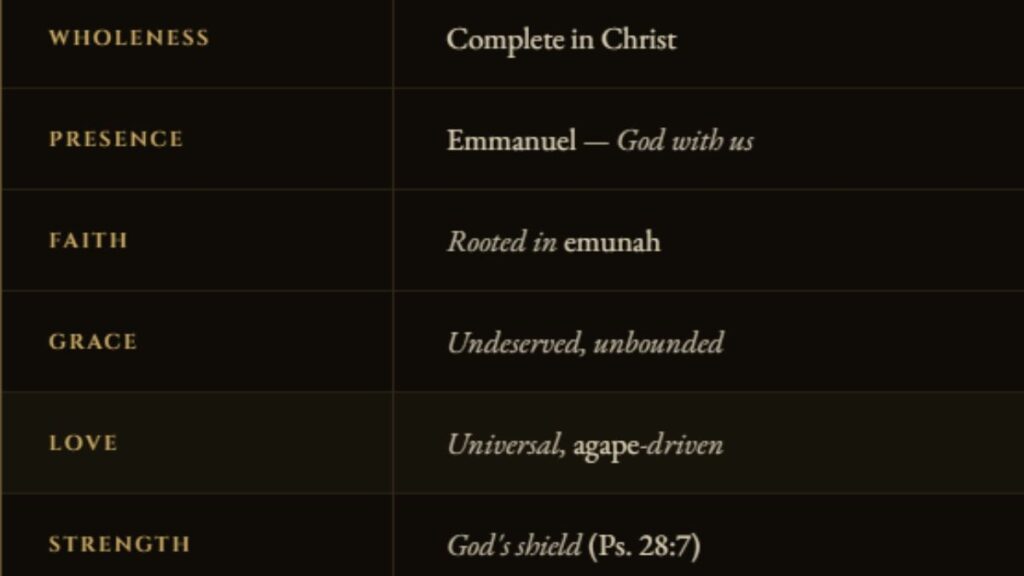
Emma’s Spiritual Core at a Glance:
Also Read: Is Tristan a Hebrew Name? Biblical Truth & Christian Perspective
Emma Meaning in Greek — Theological Vocabulary
The Emma meaning in Greek opens the New Testament’s theological vocabulary in ways that deepen every other connection in this guide.
Teleios — The Greek Heart of Emma
The Greek word teleios (τέλειος) means “complete,” “mature,” or “brought to its intended end.” James 1:4 uses it: “…that you may be mature [teleios] and complete [holokleroi], not lacking anything.”
Holokleroi (ὁλόκληροι) means “whole in every part” — sound in body, mind, and spirit simultaneously. Together these two Greek terms create a composite portrait of exactly what Emma is called to be.
Jesus uses teleios in Matthew 5:48: “Be perfect [teleios], therefore, as your heavenly Father is perfect.” Biblical scholar D.A. Carson notes this doesn’t demand sinless perfection — it calls for whole-hearted, complete devotion to God’s character. That’s Emma’s calling compressed into one verse.
Greek Theological Vocabulary Connected to Emma
| Greek Term | Transliteration | Meaning | Scripture |
| τέλειος | Teleios | Complete / mature | James 1:4; Matthew 5:48 |
| ὁλόκληροι | Holokleroi | Whole in every part | James 1:4 |
| πληρόω | Pleroo | Filled completely | Colossians 2:10 |
| ἀγάπη | Agape | Divine, unconditional love | 1 John 4:16 |
| χάρις | Charis | Grace — unmerited favor | Ephesians 2:8 |
| εἰρήνη | Eirene | Peace / wholeness | Philippians 4:7 |
| σοφία | Sophia | Wisdom | James 1:5 |
Also Read: Sienna Name Meaning in the Bible. Hebrew Roots, Saint Catherine & 2026 Stats
Emma: A Name Reflecting Biblical Virtues
Strength and Courage
Proverbs 31:17 describes the woman of noble character: “She sets about her work vigorously; her arms are strong for her tasks.” That’s not passive faith — it’s muscular, intentional obedience. Joshua 1:9 then pairs strength with presence: “Be strong and courageous… for the Lord your God will be with you wherever you go.” Notice what powers Emma’s strength — not willpower but God’s presence. That’s the Emmanuel thread woven right into her calling.
Grace and Gentleness
Colossians 4:6 instructs: “Let your conversation be always full of grace, seasoned with salt.” Grace isn’t just received — it’s transmitted through words. An Emma living her name’s meaning speaks differently than the culture around her. Proverbs 31:26 describes this woman: “She speaks with wisdom, and faithful instruction is on her tongue.”
Faithfulness and Wholeness
1 Corinthians 1:9 grounds faithfulness in God’s character first: “God is faithful, who has called you into fellowship with his Son.” You don’t generate faithfulness alone — you draw it from the Source. Hebrews 10:23 turns that truth into daily practice: “Let us hold unswervingly to the hope we profess, for he who promised is faithful.” Unswerving — that’s emunah in daily action.
Compassion and Love
Colossians 3:14 concludes its layering of virtues with this: “Above all these things put on love, which binds them all together in perfect unity.” The Greek for “perfect unity” uses teleiotētos — the noun form of teleios. Completeness comes through love. That’s Emma’s entire theological architecture in one sentence.
Emma’s Biblical Virtues — Summary:
✓ Strength — Facing life with God as shield (Psalm 28:7) ✓ Grace — Speaking with unearned kindness (Colossians 4:6) ✓ Faithfulness — Holding unswervingly to God’s promises (Hebrews 10:23) ✓ Compassion — Clothing herself with kindness (Colossians 3:12) ✓ Wholeness — Living complete in Christ (James 1:4) ✓ Courage — Moving forward despite fear (Joshua 1:9) ✓ Universal love — Loving without partiality (Romans 12:18)
Also Read: What Does Charlotte Mean Biblically? Freedom in Christ + 7 Prayers for Your Daughter
Emma Across Christian Traditions and Languages

One section no competitor article covers: how Emma functions across different Christian cultural traditions worldwide.
Emma in Latin American Catholic tradition: Spanish-speaking Catholic families have long used Emma — particularly in Mexico, Colombia, and Argentina — where it carries the same Immanuel resonance but is often paired with saints’ names. Emma María and Emma Sofía are popular combinations that layer the Marian and wisdom traditions onto Emma’s wholeness meaning.
Emma in French Catholic tradition: France has a historic connection to Emma through Emma of Normandy herself. French Catholic families celebrating Emma’s name day on June 29th often connect it to the feast of Saints Peter and Paul — an association with foundational, unshakeable faith that pairs beautifully with Emma’s emunah connection.
Emma in German Lutheran tradition: Germany, where the name originated linguistically, retains Emma as a top-10 name. German Lutheran families often emphasize the ermen root directly — wholeness in God’s design — connecting it to Luther’s emphasis on the believer’s complete justification before God. Nothing left to prove. Nothing left to earn.
Emma in Anglican tradition: In England and Wales, Emma ranked #14 in 2023 (ONS data). Anglican families frequently choose Emma for its combination of historical dignity (Queen Emma of Normandy) and theological depth — a name that works in the cathedral and at the kitchen table simultaneously.
Comparing Emma to Similar Christian Names
Many parents consider Emma alongside theologically similar names. Here’s how it compares:
| Name | Core Meaning | Theological Depth | Biblical Appearance |
| Emma | Whole, universal, complete | Very high — Colossians 2:10, teleios, shalom | Not in Scripture directly |
| Grace | God’s unmerited favor | High — Ephesians 2:8 | Conceptually throughout NT |
| Faith | Trust in God | High — Hebrews 11:1 | Named directly in concept |
| Hope | Expectation of God’s promise | High — Romans 15:13 | Named directly in concept |
| Hannah | Grace / God’s favor | High — 1 Samuel 1 | Character in OT |
| Naomi | Pleasant / delightful | Moderate — Ruth 1 | Character in OT |
| Emmanuel | God with us | Very high — Matthew 1:23 | Named in prophecy |
The key distinction: Grace, Faith, and Hope each name one dimension of the Christian life. Emma names the state of being from which all those dimensions flow. If you want a name that encompasses the whole theological package, Emma is unmatched in the current top 10.
Read Also: Anthony Name Meaning: Biblical & Spiritual Significance
Emma in the Christian World Today — 2026 Data
United States (SSA official release, May 9, 2025):
- Emma ranked #2 for 2024 — its sixth consecutive year in that position
- 14,435 babies named Emma in the US in 2024
- Olivia held #1 for the sixth consecutive year
- SSA 2025 data expected May 2026 — this article updates upon release
- Source: ssa.gov/oact/babynames
Global rankings (most recent confirmed data):
| Country | Rank | Source | Year |
| United States | #2 | SSA | 2024 |
| England & Wales | #14 | ONS | 2023 |
| Australia | #9 | ABS | 2023 |
| Germany | Top 10 | GfdS | 2023 |
| Canada | Top 10 | Statistics Canada | 2023 |
England/Wales ONS data for 2024 expected early 2026 — article updates upon release.
Emma paired with biblical middle names:
| Name Combination | Combined Theological Meaning |
| Emma Grace | Complete in grace |
| Emma Faith | Whole in trust |
| Emma Ruth | Complete loyalty |
| Emma Hope | Whole in expectation |
| Emma Joy | Universal joy |
| Emma Claire | Whole and radiant |
Notable Christians named Emma:
- Emma Danzey — Christian author and founder of Twist of Faith ministry (active 2025–2026)
- Emma Mae Jenkins — Gospel-influenced recording artist and worship leader
- Saint Emma of Gurk — 11th-century Austrian saint; gave everything to serve the poor
Read Also: Biblical Meaning of William: Hebrew Origin & Calling (2026)
Emma: A Name to Live By
A name shapes the story you tell yourself about who you are. For Emma, that story begins with wholeness — not as something to achieve but as something already given in Christ.
Daily affirmations rooted in Emma’s meaning:
“I am whole in Christ — not eventually, but right now” (Colossians 2:10). This one shifts everything. Emma doesn’t strive toward completion — she lives from it. “God is with me today, not just in my best moments” (Hebrews 13:5). On hard days, the Emmanuel resonance is the anchor. “I extend compassion because I’ve already received it” (Ephesians 4:32). Grace given out always flows from grace received.
Emma’s Daily Prayer:
Lord, You formed me for wholeness. When circumstances make me feel broken, remind me I’m already complete in Christ. When fear rises, remind me You’re Emmanuel — with me in this exact moment. Let strength flow from Your presence, grace flow from Your character, and love flow without limits through me today. Amen.
Baby Dedication Framework:
Build Emma’s dedication around three spoken declarations:
- “You are whole in Christ.” — Colossians 2:10
- “God is always with you.” — Matthew 1:23
- “You are clothed with strength and dignity.” — Proverbs 31:25
Then frame Zephaniah 3:17 for the nursery. Let her grow up seeing that God doesn’t just tolerate her — He rejoices over her with singing.
Emma as a Confirmation Name:
Catholic and some Anglican families choose Emma specifically at confirmation because its completeness theology aligns with the sacrament’s meaning — receiving the fullness of the Holy Spirit. If you’re exploring confirmation names, Emma’s theological depth makes it one of the strongest available choices.
FAQs
What does Emma mean in the Bible?
Yes — Emma carries profound, documented biblical meaning. Emma means “whole,” “universal,” and “complete” from Old High German ermen, connecting powerfully to Emmanuel (“God with us,” Matthew 1:23), the fullness of Christ (Colossians 2:10), and the Greek teleios (mature and complete, James 1:4). Emma doesn’t appear as a scriptural character — but its theological roots run deeper than most names that do.
What is the true meaning of the name Emma?
The true meaning is “whole,” “universal,” and “complete” — from Old High German ermen, documented in Frankish royal records since the 8th century CE. Spiritually, it declares the wholeness every believer already possesses in Christ as a present reality, not a future goal. Colossians 2:10 states it plainly: “You have been brought to fullness in Christ” — not eventually, but now.
Is Emma a good Christian name?
Absolutely yes — Emma is one of the most theologically rich Christian names available today. It grounds identity in wholeness in Christ (Colossians 2:10), echoes Emmanuel (“God with us,” Matthew 1:23), and has been carried by Christian saints since the 11th century. Saint Emma of Gurk sold her entire fortune to serve people with low-income and founded a cathedral still standing today — that is the legacy quietly embedded in this name.
Does Emma mean “my God has answered”?
No — this is a well-circulated misconception that confuses Emma with entirely different name traditions. Emma means “whole” or “universal” from Germanic ermen roots. The name most tied to God answering prayer is Hannah (meaning “grace” or “God’s favor”), whose story in 1 Samuel 1 centers entirely on God responding to desperate prayer. Emma and Hannah carry different etymologies but share genuinely beautiful biblical resonance.
What nationality is the name Emma?
Emma is Germanic in origin — derived from Old High German ermen, first documented in Frankish royal compound names as early as the 8th century CE. It spread through medieval Europe through Queen Emma of Normandy (c. 985–1052), queen of both England and Denmark. Today it remains in the top 100 across the US, UK, Australia, Germany, and Canada, with particular dominance in Germany where the name was linguistically born.
Is Emma a rare name?
No — and for many Christian families, that endurance is the entire point. Emma ranked #2 in the United States for 2024 per official SSA data released May 9, 2025, with 13,485 babies given that name in a single year. It has remained in the top 5 in the US since 2002. Parents don’t choose Emma because it’s rare — they choose it because its meaning doesn’t expire with the decade.
What makes Emma unique compared to other Christian baby names?
Emma is uniquely complete as a Christian name — where Grace names one virtue, Faith names one virtue, and Hope names one virtue, Emma names the theological foundation from which all of them flow. Galatians 5:22–23 describes the fruit of the Spirit as one unified whole, not a collection of separate traits. Emma names the tree. Every popular Christian virtue name names a single branch growing from it.
What is the Hebrew meaning behind the name Emma?
Yes — Emma carries genuine Hebrew spiritual resonance, even without direct etymological lineage. Emma beautifully echoes Immanuel (עִמָּנוּאֵל, “God with us,” Isaiah 7:14 fulfilled in Matthew 1:23), emunah (אֱמוּנָה, steadfast faithfulness — the root of “amen”), and shalom (שָׁלוֹם, wholeness-peace). These aren’t linguistic claims — they’re honest spiritual connections that deepen Emma’s theological identity powerfully.
What does Emma mean spiritually for a Christian girl?
Spiritually, Emma declares three unshakeable truths over a daughter’s life before she speaks her first word: she is already whole in Christ (Colossians 2:10), God is always present with her (Hebrews 13:5), and her capacity for love carries no borders (1 Corinthians 13:7). Emma isn’t a name she grows into — it’s a covenant identity Christ already secured on her behalf.
What Bible verse best represents the name Emma?
Yes — and it’s one most people never connect to this name. Zephaniah 3:17 captures Emma’s complete spiritual meaning: “The Lord your God is with you, the Mighty Warrior who saves. He will take great delight in you; in His love He will rejoice over you with singing.” God’s presence and His delight in wholeness — the entire theological soul of Emma’s name, in a single verse.
What is the Greek meaning of the name Emma?
Yes — Emma connects directly to the Greek theological term teleios (τέλειος), meaning “complete,” “mature,” and “brought to its intended end.” James 1:4 uses it: “that you may be mature and complete, not lacking anything.” Jesus himself uses teleios in Matthew 5:48, calling believers to wholehearted, complete devotion to God — exactly the identity Emma’s name carries.
Is Emma a saint’s name in Catholic tradition?
Yes — Saint Emma of Gurk (975–1045 AD) is Emma’s primary patron saint in Catholic tradition. Born into Austrian nobility, she gave away her entire fortune after her husband’s death, founding the Gurk Cathedral in Carinthia, Austria — a pilgrimage site still visited today, documented in Vatican records. Her life is Emma’s meaning lived with nothing held back: wholeness poured out completely for others.
What middle name goes best with Emma for a Christian baby?
Yes — several biblical middle names pair perfectly with Emma to create layered theological meaning. Emma Grace declares “complete in grace,” Emma Faith means “whole in trust,” Emma Ruth reflects “complete loyalty,” and Emma Hope speaks “whole in expectation.” Each pairing anchors a specific virtue onto Emma’s foundational wholeness — giving your daughter a name that tells a full and beautiful theological story.
Final Thoughts: Living the Emma Legacy
Yes , and once you understand it, you’ll never hear this name the same way again.
Emma means “whole,” “universal,” and “complete.” But what Emma means in the Bible runs deeper than etymology. It runs straight into the heart of who God says your daughter already is — before she speaks, before she strives, before she proves anything to anyone.
Colossians 2:10 doesn’t whisper it. It declares: “You have been brought to fullness in Christ.” Not eventually. Now.
14,435 babies were named Emma in 2024 alone — SSA’s official data confirming #2 for the sixth consecutive year. Those families didn’t choose a trend. They chose theology.
From Emmanuel’s promise in Matthew 1:23, to the Greek teleios of James 1:4, to Saint Emma of Gurk who poured out everything she owned for people with low-income in 1045 AD — this name has always pointed toward one unshakeable truth.
God doesn’t just tolerate your Emma. Zephaniah 3:17 says He rejoices over her with singing.
That’s what Emma means in the Bible. Wholeness already given. Presence never withdrawn. Love without a single asterisk.
Raise her knowing it. Watch it become her.

Welcome to humorclique ! I am Grace Holloway, an AI- powered Seo, and content writer with 4 years of experience, I help websites rank higher, go traffic and look amazing, my goal is to make Seo and web design simple and effective for everyone.
Lets achieve more together!