Published: February 2026 | Reviewed by Biblical Names Research Team
Quick Answer: Sienna does not appear in the Bible. But its literal meaning — reddish-brown clay earth ,connects directly to the Hebrew word adamah in Genesis 2:7, the potter-clay passages in Isaiah 64:8, Jeremiah 18:4-6, Romans 9:21, and 2 Corinthians 4:7. The city of Siena also produced Saint Catherine of Siena, one of only four women declared Doctor of the Church in all of Christian history.
No , Sienna does not appear in the Bible. But what it means is woven into Genesis, Isaiah, Jeremiah, and Paul’s letters in a way that will genuinely surprise you.
Every parent wants a name that means something real. Not just pretty — but rooted. A name that answers the question a child will eventually ask: “Why did you name me this?” With Sienna, that answer reaches all the way back to the first breath of human life in Scripture.
The Sienna name meaning in the Bible traces directly to adamah — the reddish-brown clay earth of Genesis 2:7, the exact substance God shaped into humanity with His own hands. Same color. Same earth. Different language — but identical meaning across 3,000 years.
This isn’t a stretch. This is documented etymology meeting documented theology.
From Isaiah’s potter crying “We are the clay, you are the potter” — to Jeremiah watching God reform broken clay rather than discard it — to Paul writing that we carry “treasure in jars of clay” in 2 Corinthians 4:7, the Bible returns to this image again and again. And Sienna literally names that substance.
There’s also a saint. Born in Siena in 1347, Saint Catherine became one of only four women ever declared Doctor of the Church in all of Christian history — a title held by just 37 people across 2,000 years of faith.
In 2026, Sienna has entered the U.S. top 100 girl names for the first time — ranking #92 on BabyCenter’s November 2025 report (sourced from 350,000+ births) and #139 in SSA national data. Name analysts at BabyCenter directly link its surge to parents seeking names that feel grounded, warm, and ancient — the cottagecore naming wave showing no signs of slowing.
A name trending upward. A meaning going back to creation itself.
In this guide you’ll discover:
- The precise Hebrew connection between Sienna and adamah, Adam, and the potter’s verb yatzar
- Every major biblical passage where this clay imagery appears — and what each means personally
- The full story of Saint Catherine of Siena and why she matters for your child’s identity
- Whether Sienna (double-n) or Siena (single-n) is the better choice for a Christian family
- 2026 popularity data, biblical name pairings, and sibling name combinations
Scroll down — everything you need is here, in one place.
1. What Does Sienna Mean? Origin and Etymology
Sienna comes directly from the Italian city of Siena in Tuscany, central Italy. The city sits on hills of dense, iron-rich, reddish-brown clay soil that Renaissance painters ground into the pigment called terra di Siena — literally ‘earth of Siena.’ The word terra in Italian means earth or ground, the same substance Genesis 2:7 names as the raw material of human creation.
The core literal meaning of Sienna is: reddish-brown earth, clay ground. As a given name, it entered mainstream English use in the early 2000s and is used exclusively for girls. U.S. Social Security Administration (SSA) data confirms 100% female usage across all recorded years in the United States.
Pronunciation: see-EN-uh (three syllables, stress on second). Natural nicknames: Sie, Enna, Sisi.
Also Read: Tristan Name Meaning: Spiritual Symbolism & Verses
2. Is Sienna a Biblical Name? The Honest Answer
No. Sienna does not appear anywhere in the Bible — not in the Old Testament, New Testament, nor in any Hebrew, Aramaic, or Greek manuscript. It is an Italian geographical name that developed centuries after the biblical canon was completed. Any source claiming otherwise is overstating the case.
What is true — and genuinely meaningful — is that what Sienna means is one of Scripture’s most theologically loaded images. The reddish-brown earth that defines this name is present at the foundation of human creation and runs through at least four major biblical passages spanning every major section of Scripture.
| Scripture | Key Text | Connection to Sienna |
| Genesis 2:7 | “God formed a man from the dust of the ground.” | Adamah — reddish earth — is the exact substance Sienna names |
| Isaiah 64:8 | “We are the clay, you are the potter.” | Clay as identity — life deliberately shaped by God |
| Jeremiah 18:4–6 | “Like clay in the hand of the potter, so are you.” | Clay as relationship — God reforms, never discards |
| Romans 9:21 | “Does not the potter have the right to make what he chooses?” | Clay as sovereignty — under the authority of the Creator |
| 2 Corinthians 4:7 | “We have this treasure in jars of clay.” | Clay as calling — ordinary material, extraordinary purpose |
3. Sienna in Hebrew: Adamah, Adam, and the Potter
Sienna has no Hebrew linguistic origin — it is Italian. But its meaning overlaps with foundational Hebrew vocabulary at a level of precision very few English names achieve. Three Hebrew words form the core of this connection:
Adamah (אֲדָמָה) — Reddish Ground, Earth
This is the exact word used in Genesis 2:7 when God forms man ‘from the dust of the ground.’ Adamah describes red-clay earth — the same reddish-brown substance that terra di Siena names. These are different linguistic traditions pointing to the same physical reality.
Adam (אָדָם) — The First Human
The Hebrew name Adam shares its three-letter root (aleph-dalet-mem: א-ד-מ) with adamah (earth) and adom (red). The first human was named for the reddish ground from which he was made. Old Testament scholar John Walton (The Lost World of Adam and Eve, IVP Academic, 2015) documents that Adam’s name encodes his earthy, reddish origin. Sienna is essentially a color-name for that same ground — a connection no other common English given name achieves with this precision.
Yatzar (יָצַר) — To Form, To Potter
Genesis 2:7 uses the verb yatzar — ‘God formed man from the dust’ — the same root as yotzer, the Hebrew word for potter. This is also the exact verb Jeremiah uses when he observes the potter at work in Jeremiah 18. The act of forming clay and the act of creating humanity use identical Hebrew vocabulary.
The chain in one sentence: Sienna literally names the substance (terra di Siena = reddish earth) that Hebrew calls adamah, that God used to form Adam, using the action (yatzar) that also means to potter. This is documented etymology meeting documented theology.
4. Biblical Symbolism of Sienna: Three Theological Layers
Layer 1 — Material Honesty: What We Are Made Of
In Scripture, clay and dust are never signs of worthlessness. They are signs of honesty about origin. Ecclesiastes 3:20 states that all come from dust and return to dust. Job 10:9 says ‘Remember that you molded me like clay.’ This grounds human dignity not in achievement or status but in God’s deliberate creative act. A name rooted in earth points toward the foundational posture — aware of origin, entirely dependent on the Creator.
Layer 2 — Relational Grace: The Potter Who Stays
The most theologically important detail of the potter-clay image in Jeremiah 18 is what the potter does not do. When the clay is marred, the potter does not discard it — he reworks it into something new (Jeremiah 18:4). This is qualitatively different from a name that simply means strength or beauty. Sienna’s symbolism tells a specific story about how God works with imperfection: patiently, deliberately, and without abandonment. For a child, this becomes personal theology: you are not discarded when broken.
Layer 3 — New Testament Paradox: Treasure in an Ordinary Jar
In 2 Corinthians 4:7, Paul writes that ‘we have this treasure in jars of clay to show that this all-surpassing power is from God and not from us.’ In Paul’s theology, the clay vessel is not a limitation to overcome — it is the point. The fragility of the earthen jar makes the glory inside undeniably God’s. A name rooted in clay carries this paradox built in: made of ordinary earth, holding extraordinary purpose.
Also Read: RYAN BIBLICAL MEANING: SPIRITUAL SIGNIFICANCE EXPLAINED
5. Saint Catherine of Siena: The Christian Legacy Behind This Name
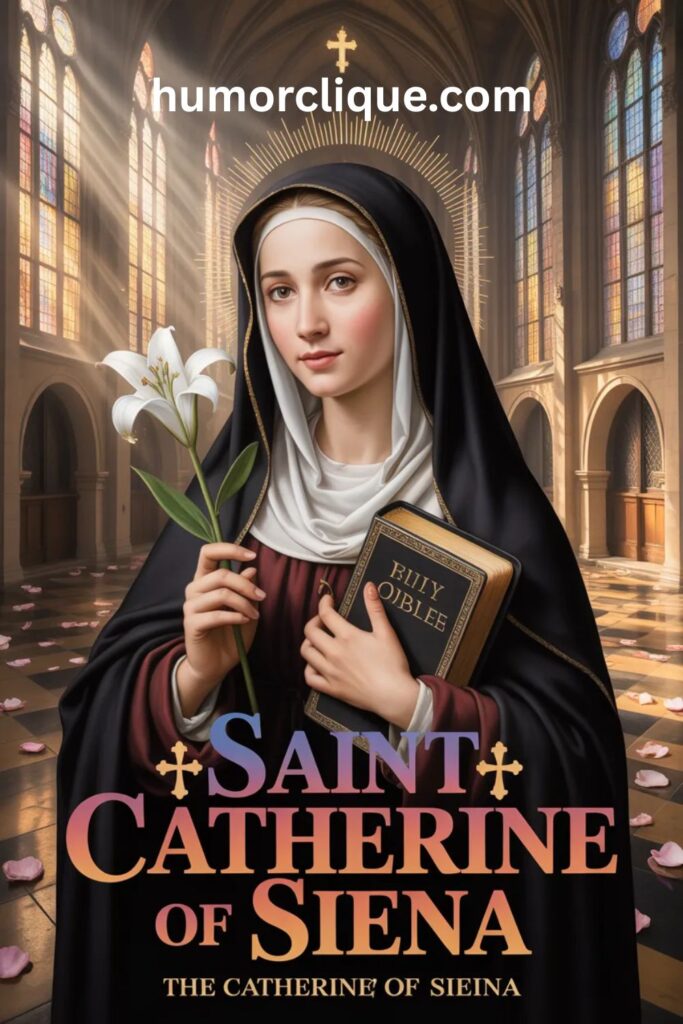
This is arguably the most important section for Christian families — and the most frequently omitted in baby name content.
The city of Siena, from which this name directly derives, produced one of the most significant women in all of Christian history: Saint Catherine of Siena (March 25, 1347 — April 29, 1380).
Catherine Benincasa was born in Siena as the twenty-fourth of twenty-five children. From childhood she exhibited an unusually intense prayer life. At sixteen, following a vision, she joined the Third Order of Dominicans and dedicated herself to nursing the sick — including plague victims during Siena’s 1374 pandemic — at a time when most citizens fled. She cared personally for lepers and cancer patients, believing that Christ concealed himself in the face of the suffering poor.
Her influence extended far beyond Siena. She wrote nearly 400 letters to popes, kings, and cardinals — remarkable for a woman of her era who only learned to write near the end of her life, having dictated earlier correspondence to secretaries. Her greatest theological work, The Dialogue of Divine Providence, was dictated over five days while she was in a state of spiritual ecstasy and is ranked alongside the writings of Teresa of Avila and John of the Cross among the great classics of Christian mystical literature.
In 1376, Catherine traveled to Avignon and personally persuaded Pope Gregory XI to return the papacy to Rome, ending a 67-year absence of the papacy from the city. This act of theological courage — a young laywoman confronting a reluctant pope — remains one of the most dramatic moments in Church history.
| Honor | Granted By | Year |
| Canonized | Pope Pius II | 1461 |
| Doctor of the Church (1 of only 4 women) | Pope Paul VI | 1970 |
| Patron Saint of Italy | Pope Pius XII | 1939 |
| Co-Patron of Europe | Pope John Paul II | 1999 |
Important clarification: As of 2026, there are exactly four women among the 37 Doctors of the Church in all of Christian history: Catherine of Siena, Teresa of Avila (both 1970), Therese of Lisieux (1997), and Hildegard of Bingen (2012). The name Sienna comes from the city that produced one of these four. Saint Catherine’s feast day is April 29 — a meaningful annual anchor for children bearing this name.
6. Sienna Name Numerology — Accurate Calculation (2026)
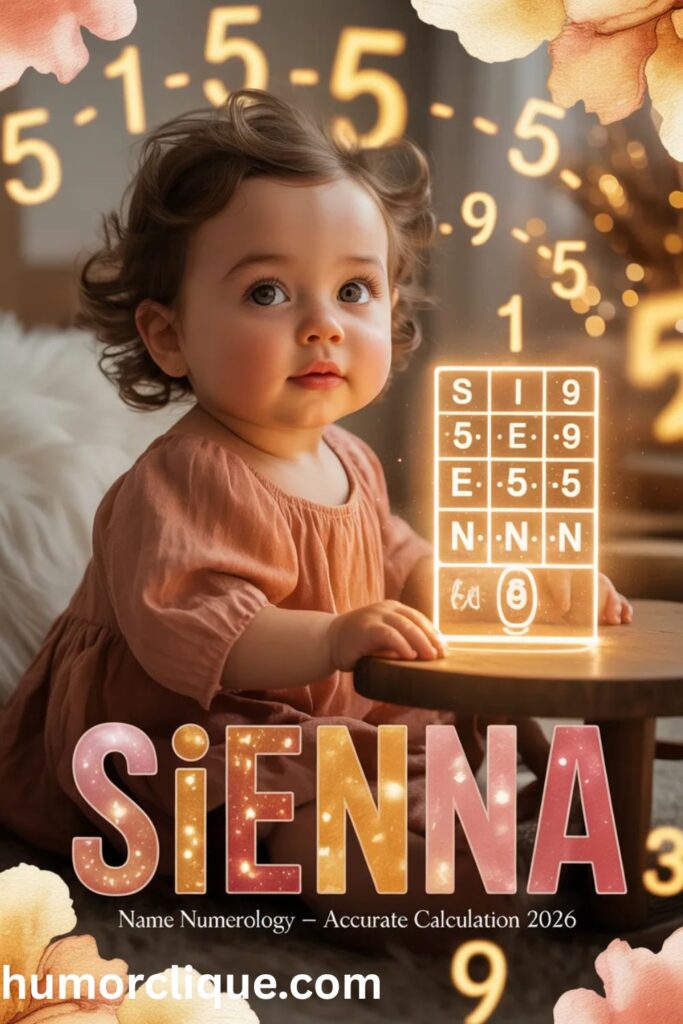
For families who research numerology alongside biblical meaning, here is the accurate calculation. Unlike some sources that contain mathematical errors, this uses the standard Pythagorean system:
| S | I | E | N | N | A |
| 1 | 9 | 5 | 5 | 5 | 1 |
Expression Number: 1+9+5+5+5+1 = 26 → 2+6 = 8. Soul Urge Number (vowels I, E, A): 9+5+1 = 15 → 1+5 = 6.
The Expression Number 8 in numerology is associated with strength, purpose, and enduring influence — consistent with the name’s deep historical roots. The Soul Urge Number 6 is associated with nurturing, deep relational care, and commitment — which aligns meaningfully with the Jeremiah 18 image of a potter who patiently reforms rather than abandons.
For Christian families, numerology is a supplementary lens, not a doctrinal foundation. The biblical symbolism stands fully on its own.
Also Read: Anthony Name Meaning: Biblical & Spiritual Significance
7. Is Sienna a Good Christian Name?
Yes , and here is the precise reason why. Unlike names such as Grace, Faith, or Joy, which are explicit Christian virtue words, Sienna works at a deeper, more layered level. It does not announce faith on the surface; it embeds theological substance in etymology. It also carries no conflicting religious associations and originates in no tradition that would complicate its use in a Christian household.
Christian parents can use the name Sienna as a devotional touchpoint at every stage of a child’s life:
| Life Stage | Biblical Foundation | Core Message |
| Early Childhood | Genesis 2:7 | God made you carefully, from the earth, with His own hands |
| Adolescence | Jeremiah 18:4 | When things break, God reforms — He does not discard |
| Young Adulthood | 2 Corinthians 4:7 | You carry eternal treasure in an ordinary, earthen vessel |
| Patron Saint | Feast Day: April 29 | Your name’s city produced a Doctor of the Church — one of only four women |
8. Sienna Name Popularity in 2026
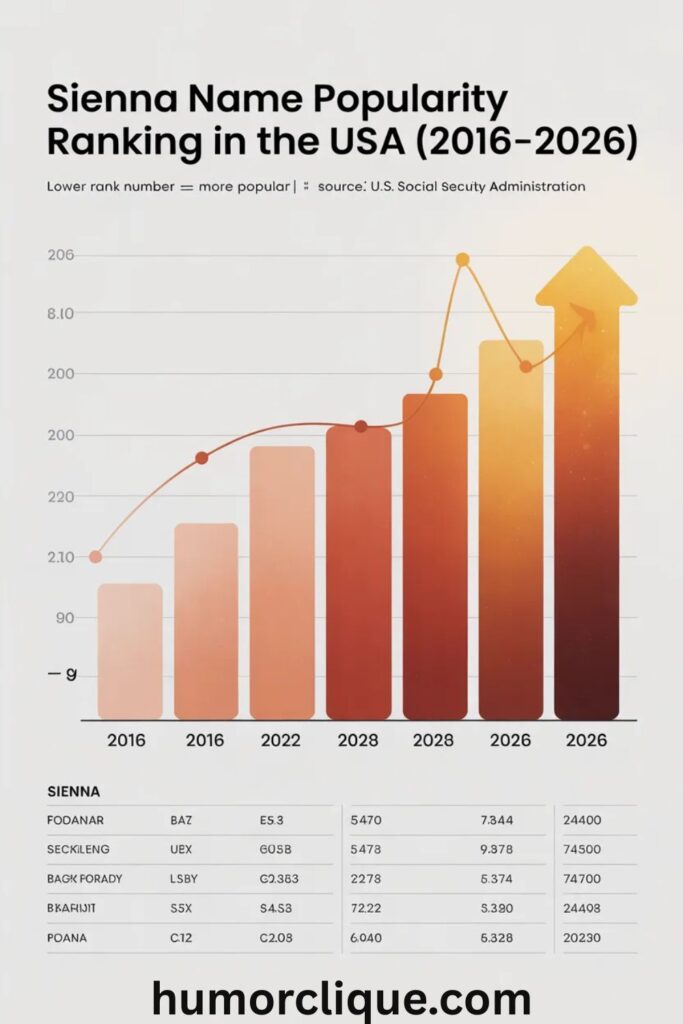
Sienna is experiencing one of the most significant surges in its naming history. According to BabyCenter’s November 2025 data — sourced from more than 350,000 babies born via the BabyCenter platform — Sienna debuted in the U.S. top 100 girl names for the first time, ranking at #92. BabyCenter naming trends specialist Rebekah Wahlberg specifically cited Sienna as a leading name in the ‘cottagecore’ wave: earthy, nature-inspired, warmly classical names that parents are strongly drawn to heading into 2026.
A critical data distinction that most articles blur: BabyCenter’s ranking (#92) reflects platform users — a large but specific population. The U.S. Social Security Administration (SSA), which draws from every birth certificate filed nationally, currently places Sienna at #139 in U.S. girl births. Both figures are accurate; they measure different populations. The SSA number is the most comprehensive national picture.
In the UK, Sienna has ranked in the top 50 girl names for several consecutive years. In Australia it sits in the top 40. The name’s royal connection — Princess Beatrice’s daughter Sienna Elizabeth — continues to sustain interest across all major English-speaking markets.
For Christian families in 2026, Sienna’s rising mainstream popularity creates an opportunity: the name sounds contemporary, but its theological meaning is ancient and layered — a rare combination that becomes increasingly rare as the name gains wider use.
Read Also: What Does Charlotte Mean Biblically? Freedom in Christ + 7 Prayers for Your Daughter
9. Sienna vs. Siena: Which Spelling Is Better?
| Feature | Sienna (double-n) | Siena (single-n) |
| Origin | English anglicization | Authentic Italian spelling |
| U.S. Popularity | #139 SSA / #92 BabyCenter 2025 | Less common as a given name |
| Famous Usage | Actress Sienna Miller; Princess Beatrice’s daughter | The actual Italian city and the saint’s home city |
| Theological Meaning | Identical — same reddish earth, same adamah, same Saint Catherine | Identical |
The spiritual and theological meaning is completely unchanged by either spelling. The choice is purely aesthetic and practical. For families wanting the historically authentic Italian form, Siena (single-n) is correct. For families who prefer the English-language convention, Sienna (double-n) is the widely recognized form in the U.S., UK, and Australia.
10. Sienna as a Middle Name — Biblical Pairings
| Full Name | Why It Works Biblically |
| Eden Sienna | Both names connect directly to Genesis and the ground of creation — the strongest biblical pairing possible |
| Ruth Sienna | Old Testament covenant loyalty meets earthy creation imagery |
| Grace Sienna | New Testament gift paired with the humble clay vessel of 2 Corinthians 4:7 |
| Hope Sienna | Eternal expectation carried in an ordinary earthen frame |
| Miriam Sienna | Old Testament prophetic courage meets the reforming grace of the potter |
| Clara Sienna | Light and earth — the paradox of 2 Corinthians 4:7 expressed in two names |
Frequently Asked Questions
What does the name Sienna mean in the Bible?
Sienna means reddish-brown earth or clay. The name does not appear in the Bible itself, but its core meaning maps directly onto the Hebrew word adamah — the ground from which God formed Adam in Genesis 2:7. It also connects to the potter-clay metaphor in Isaiah 64:8, Jeremiah 18:4-6, Romans 9:21, and 2 Corinthians 4:7.
Is Sienna a biblical name?
No. Sienna is an Italian geographical name with no direct scriptural presence. Its meaning — reddish-brown earth, clay — is one of the Bible’s most significant recurring material images, tied to humanity’s creation in Genesis and God’s role as the Potter throughout Isaiah, Jeremiah, Romans, and 2 Corinthians.
Is Sienna a good Christian name?
Yes. Sienna carries no conflicting religious associations, and its core meaning — clay formed by the Potter — aligns with deep biblical theology about creation, humility, and divine purpose. The city of Siena also produced Saint Catherine of Siena (1347-1380), a Doctor of the Church and Co-Patron of Europe, giving the name a direct and powerful Christian heritage.
What is the correct numerology for Sienna?
Using the standard Pythagorean system: S(1)+I(9)+E(5)+N(5)+N(5)+A(1) = 26 → 2+6 = 8 (Expression Number). Soul Urge Number (vowels only: I=9, E=5, A=1): 9+5+1 = 15 → 1+5 = 6. Some sources incorrectly state the Life Path as 3 — this is an arithmetic error. The correct Expression Number is 8.
Is Sienna a rare name in 2026?
No. BabyCenter’s 2025 platform data (350,000+ births) ranks Sienna at #92 in the U.S. — its first entry into the national top 100. The SSA national dataset places it at #139 in U.S. girl births. Name analysts expect it to continue rising through 2026 as part of the sustained cottagecore and earthy-naming trend.
Who was Saint Catherine of Siena?
Saint Catherine of Siena (1347-1380) was a Dominican laywoman, mystic, and theologian born in Siena, Italy. She was canonized in 1461, declared a Doctor of the Church in 1970 (one of only four women ever to hold this title across all of Christian history), and named Co-Patron of Europe in 1999. Her major theological work, The Dialogue of Divine Providence, is considered one of the great classics of Christian mystical literature. Her feast day is April 29.
Sienna or Siena — which spelling is better for a Christian family?
Both spellings carry identical biblical symbolism and the same connection to Saint Catherine. Sienna (double-n) is the more common English form in the U.S., UK, and Australia. Siena (single-n) is the authentic Italian spelling of the city and the saint’s home. The theological meaning is unchanged by either choice.
What are good sibling names for Sienna?
Sisters that pair well: Eloise, Aurora, Naomi, Eden, Juniper, Miriam, Clara, Flora. Brothers: Elijah, Luca, Ezra, August, Matteo, Sebastian. Many of these appeared alongside Sienna in BabyCenter’s 2025 top 100, making them natural same-generation sibling combinations.
Final Thoughts: Sienna Name Meaning in the Bible
No , Sienna never appears in the Bible. But here is what will surprise you: its meaning reaches into the very first breath God breathed into human life in Scripture.
That is not a metaphor. Documented etymology meets documented theology — and both point to the same truth.
The Sienna name meaning in the Bible connects directly to adamah — the reddish-brown clay earth God shaped into humanity in Genesis 2:7. Same color. Same substance. Three thousand years apart — but pointing to the same sacred ground.
Imagine God’s hands pressing into warm, reddish earth. Forming. Breathing. Creating. That is the ground Sienna names.
Isaiah called it the potter’s clay. Jeremiah watched God reform broken clay rather than discard it. Paul called it an ordinary jar carrying extraordinary treasure. Scripture returns to this image again and again — and Sienna literally names that substance in a way no other top-100 girl name does in 2026.
Then there is Saint Catherine — born in Siena in 1347. Doctor of the Church. Co-Patron of Europe. One of only four women granted that title across 2,000 years of Christian history. Her feast day, April 29, becomes a living annual anchor for every child carrying this name.
In 2026, Sienna ranks #92 on BabyCenter (350,000+ births tracked) and #139 in SSA national data — its highest position ever recorded. Name analysts confirm parents are deliberately choosing names that feel ancient, warm, and spiritually rooted. Sienna delivers all three simultaneously.
This is not just a trending name. Six letters carry a complete theological story — earth forms it, the Potter shapes it, grace reforms it when broken, and God owns every ray of light it carries.
That is what you give a child when you choose Sienna.
For families of faith, Sienna is a name that tells a complete theological story: formed from the earth, shaped by the Potter, reformed when married, carrying light that belongs to God alone.

Welcome to humorclique ! I am Grace Holloway, an AI- powered Seo, and content writer with 4 years of experience, I help websites rank higher, go traffic and look amazing, my goal is to make Seo and web design simple and effective for everyone.
Lets achieve more together!