QUICK ANSWER
Isla means “island” — a symbol of divine encounter, sacred solitude, and a soul set apart. The name does not appear in the Bible, but its meaning maps directly onto island imagery used throughout scripture (Revelation 1:9, Isaiah 42:10–12, Psalm 97:1). A symbolic parallel with the Hebrew word Ayal (deer, Psalm 42:1) adds a second layer: intense longing for God. For Christian families, Isla is deeply meaningful by resonance — not by direct citation, and that distinction matters.
No, Isla does not appear in the Bible. But neither does Grace. Neither does Faith. Neither does Hope. And yet nobody questions whether those names belong in a Christian home.
Is Isla a biblical name by direct citation? No. Is it a name whose meaning lives and breathes inside scripture — from John’s exile on Patmos to the desperate thirst of Psalm 42:1? Completely and without question.
Three thousand years ago, a poet wrote about a deer panting for water it couldn’t yet see. That raw, honest longing for God is the spiritual heartbeat of Isla’s meaning — and it has never stopped beating across centuries of Christian faith.
Is Isla a biblical name with real spiritual depth? It has ranked top 5 in England for over a decade — and the parents choosing it are discovering a name whose Christian meaning, Hebrew roots, and Celtic spiritual history run deeper than almost any modern name can match.
This guide answers with every Hebrew root, every island passage, and every Celtic saint who prayed on the same sacred shoreline this name comes from.
By the end, you won’t just understand Isla’s biblical and spiritual meaning. You’ll feel exactly why it belongs in a Christian home.
What Does the Name Isla Mean?
Isla means “island.” The name carries two linguistic roots that converge on the same image. In Scottish Gaelic, it is tied to the Isle of Islay — one of the Hebridean islands off Scotland’s west coast, a place with a documented Christian heritage stretching back to the sixth century. In Spanish, isla is simply the word for island, increasingly adopted as a given name in its own right.
What elevates this beyond decorative etymology is the theological weight the island image carries. In biblical teaching, land set apart by water is consistently the setting for divine encounter, prophetic clarity, and the kind of solitude in which God speaks most directly. Isla is not merely a place name. It is a symbol: a soul set apart for sacred purpose — surrounded by the world yet distinct from it, standing firm on foundations that water cannot erode.
Islands in Scripture: The Biblical World Isla Inhabits
The name Isla does not appear in scripture — but islands do, repeatedly, and always as places of spiritual significance. Three passages are particularly important for understanding the biblical resonance of this name.
| Reference | Context | Spiritual Significance |
| Revelation 1:9 | John receives the entire Book of Revelation on the Isle of Patmos | Physical isolation as the precise condition for prophetic revelation |
| Isaiah 42:10–12 | Islands and coastlands summoned to “sing to the Lord a new song” | Earth’s outermost edges called into the full chorus of worship |
| Psalm 97:1 | “Let the many coastlands be glad” at God’s reign | Islands as full participants in creation’s praise — never forgotten periphery |
The Hebrew word for islands used in Isaiah 42 is iyim (אִיִּים) — coastlands understood as the outermost edges of creation, summoned back toward God. In the biblical imagination, islands are not forgotten periphery. They are the farthest point still within reach of the divine call. The name Isla inhabits this world — not by direct citation, but as a living image of that theology.
Also Read: Is Tristan a Hebrew Name? Biblical Truth & Christian Perspective
Is Isla a Biblical Name?
The direct answer is no — Isla does not appear in the Bible as a personal name. But this requires a fuller answer than a simple no. Names like Grace, Faith, Hope, and Joy — used by Christian families for centuries — also appear nowhere in scripture as given names. What makes a name meaningfully biblical is whether its meaning, origin, and symbolism align with the values and imagery of scripture.
By that standard, Isla qualifies on two grounds: its island meaning maps onto consistent biblical imagery, and its symbolic Hebrew parallel connects it to some of the most beloved poetry in the Old Testament. Isla is not a biblical name by citation. It is a name whose meaning is thoroughly biblical by resonance — and for Christian families, that distinction carries real weight.
The Spiritual Meaning of the Name Isla
Four themes emerge from scripture that the name’s island meaning carries directly. These are documented biblical principles, not vague associations.
🤫 Solitude as Sacred Discipline. Moses on Sinai (Exodus 19:20). Elijah in the wilderness (1 Kings 19:12). Jesus who “often withdrew to lonely places and prayed” (Luke 5:16). Intentional solitude is the consistent precondition for divine encounter throughout scripture. Isla names a person as one formed in that tradition.
🕊 Purity of Devotion. Psalm 24:4 describes the one who may stand before God as having “clean hands and a pure heart” — an undivided whole. The island, accessible only by deliberate crossing, mirrors a life consecrated by devotion rather than by default.
🪨 Unmovable Foundation. An island is exposed on all sides — battered by storms, yet standing firm on foundations that water cannot dissolve. This is a physical parable of Psalm 46:1: not a life protected from the storm, but one that remains standing through it.
🌅 Renewal Through Separation. From the Sabbath (Exodus 20:8) to Jesus’s instruction to “go into your room and shut the door” (Matthew 6:6), scripture consistently shows that stepping apart from noise is how God’s voice becomes audible again.
Isla Name Meaning in Hebrew: The Ayal Connection
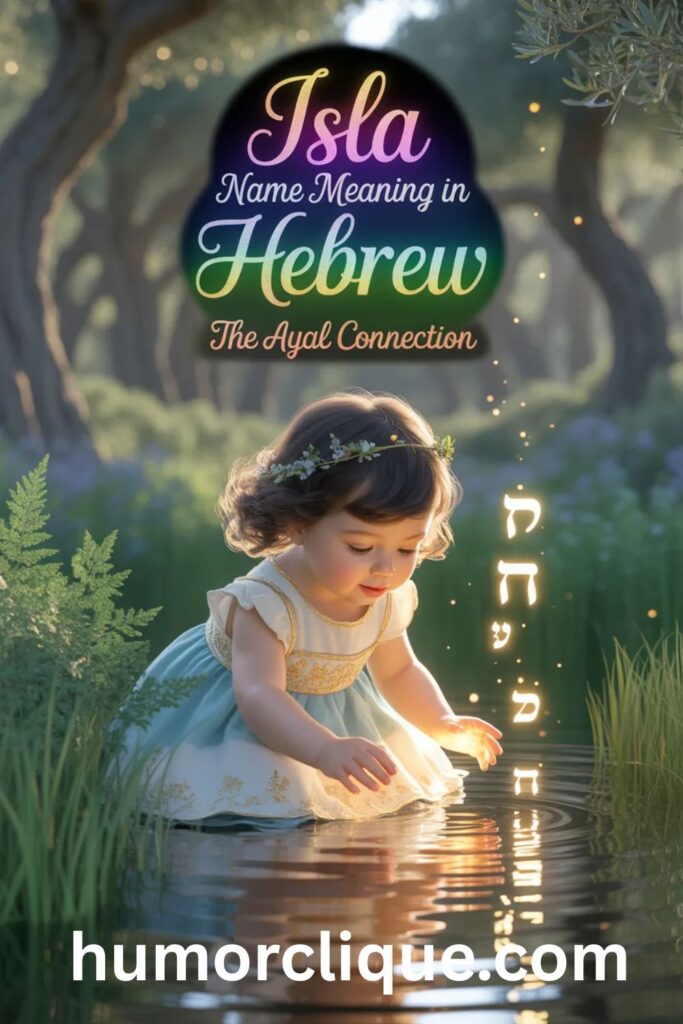
This is the most theologically substantive dimension of Isla’s biblical roots — and the one most commonly handled imprecisely by other sources. Clarity matters here, because the connection is real and meaningful, but only if correctly described.
What the Hebrew Sources Say
The Hebrew word Ayal (אַיָּל, Strong’s H354) means “stag” or “deer.” Its feminine form Ayalah (H355, אַיָּלָה) means “doe” or “hind.” Both are confirmed in the HALOT — the Köhler-Baumgartner Hebrew and Aramaic Lexicon of the Old Testament, the definitive scholarly reference for biblical Hebrew vocabulary.
Read Also: Tristan Name Meaning: Spiritual Symbolism & Verses
An Important Clarification
Isla does not derive etymologically from Hebrew. Its origin is Scottish Gaelic and Spanish — confirmed by BehindTheName.com. The connection to Ayal is symbolic and interpretive: a meaningful parallel between what the name evokes and what these Hebrew words represent in scripture. This is honest editorial analysis grounded in both sources, not an established etymological claim. The connection is genuine; it simply works through resonance rather than derivation.
| Passage | Image | Hebrew Word | Spiritual Meaning |
| Psalm 42:1 | Deer panting for streams of water | Ayal / Ayalah | Desperate, uninhibited longing for God |
| Song of Sol. 2:9, 17 | Beloved compared to a leaping gazelle | Tsvi / Tsebi | Love as swift, graceful, entirely devoted |
| Proverbs 5:19 | A graceful doe — the faithful woman | Ayalah (H355) | Beauty and devotion that hold firm without striving |
| 2 Samuel 22:34 | Feet like a deer’s — standing on the heights | Ayal (H354) | Sure-footed agility given by God, not earned by effort |
“As the deer pants for streams of water, so my soul pants for you, my God.” — Psalm 42:1 (NIV)
A parent choosing the name Isla with these connections in mind is naming their daughter after qualities embedded at the heart of Old Testament poetry: intense longing for God (Psalm 42), graceful movement through life’s terrain (2 Samuel 22), covenant faithfulness that holds without performing (Proverbs 5), and beauty that emerges from devotion rather than appearance (Song of Solomon 2). These are the lived qualities most honoured in scripture’s women — Ruth’s faithfulness, Hannah’s longing, Mary’s willingness. The name Isla, through its Hebrew symbolic roots, places a daughter in that company.
You can see: RYAN BIBLICAL MEANING: SPIRITUAL SIGNIFICANCE EXPLAINED
What Does Isla Represent in Christian Faith?
In Christian faith specifically, Isla maps onto four realities drawn directly from scripture.
Set apart for God’s purpose. Romans 12:2 commands: “Do not conform to the pattern of this world, but be transformed by the renewing of your mind.” The island is the clearest natural metaphor for this calling — present in the world, surrounded by it, yet distinct from it by nature and design. Isla names this calling without making it heavy-handed.
Longing for God’s presence. Through its Hebrew deer parallel, Isla carries the posture authentic faith most requires — not performance or obligation, but genuine thirst. The kind expressed in Psalm 42:1 with an intensity that has resonated across three thousand years of scripture reading.
God as refuge and foundation. Psalm 18:2: “The Lord is my rock, my fortress and my deliverer.” The dominant metaphor for God throughout the Psalms is solid ground in the midst of danger. Isla, rooted in the image of solid land surrounded by vast and unpredictable water, is — theologically — named for the place God is.
Graceful, rooted devotion. The gazelle imagery of Song of Solomon frames love as swift, joyful, and beautiful — not heavy, not anxious, not striving. Isla carries this quality: a faith that moves through life with quiet certainty, rooted not in effort but in the assurance of being deeply loved.
Read Also: Is Tristan a Greek Name? The Surprising Truth About Τρίσταν (2026)
Celtic Christianity and the Spiritual World of Islands

This is the dimension of the name most likely to be meaningful to families with Celtic heritage — and the one that gives Isla a historical depth few modern names can match.
Iona, Islay, and the Heartland of British Christianity
In 563 AD, the Irish missionary Saint Columba crossed from Ireland to the Isle of Iona — a small island off Scotland’s west coast, just north of the Isle of Islay from which the name Isla derives. On Iona, Columba founded the monastic community that would become the most influential centre of Christian mission in early British and northern European history. From it, monks carried the gospel across Scotland, into Northumbria, and eventually into continental Europe.
The illuminated manuscripts produced in this island tradition — including the Book of Kells — were created by monks who understood that the boundary between heaven and earth felt unusually thin in those salt-swept places.
Thin Places: A Celtic Theology of Islands
Celtic Christian theology held a distinctive view of creation: the natural world is a transparent medium through which God’s presence can be directly perceived. Coastlines, mountains, and above all islands were understood as caol áit in Gaelic — thin places, where the distance between heaven and earth narrows to almost nothing.
This theology has genuine scriptural roots. The tearing of the Temple veil at Christ’s death (Matthew 27:51) is the ultimate expression of the same principle — the barrier between human experience and divine presence becoming not thin but gone. Celtic communities were enacting in physical geography what scripture promises in spiritual reality.
The Isle of Islay itself hosted early Christian communities from at least the seventh century. The Kildalton Cross on Islay, dating to approximately 800 AD, is one of the most complete examples of Early Christian stone carving in Scotland — biblical narrative carved into a landscape saturated with sea and wind. Christianity on Islay was never an indoor religion.
What This Means for the Name
Choosing the name Isla is — knowingly or not — participating in a faith heritage where islands were literal sanctuaries, where crossing water marked spiritual transition, and where creation itself was understood as a living vehicle for divine encounter. That heritage adds a historical dimension to the name’s significance that cannot be found anywhere else.
Middle Names That Pair Well with Isla
The strongest pairings don’t merely sound pleasant — they deepen or extend Isla’s spiritual meaning. Each name below is chosen for theological resonance, not just sonic flow.
| Pairing | Meaning / Origin | Why It Works |
| Isla Grace | Latin — unearned favour | The central doctrine of Christian faith. The most theologically complete pairing, and sonically perfect. |
| Isla Joy | Latin — deep gladness | The fruit of the Spirit (Galatians 5:22). Not circumstantial happiness, but rooted gladness nothing external can remove. |
| Isla Hope | Old English — confident expectation | One of the three great Christian virtues alongside faith and love (1 Corinthians 13:13). A quiet declaration of belief. |
| Isla Faith | Latin — trust, belief | Direct and intentional. Two names whose spiritual meanings hold a genuine conversation with each other. |
| Isla Rose | Germanic — beauty from difficulty | Centuries of Christian symbolism: beauty emerging through thorns, grace in the midst of the world’s harshness. |
| Isla Noelle | French — born at Christmas | Anchors the name to the nativity — the central event of Christian history — giving it seasonal depth. |
| Isla Maeve | Old Irish — great joy | Roots both names in the same Celtic Christian tradition. Meaning and heritage align precisely. |
| Isla Skye | Norse — sky, creation | Extends Isla’s theology outward: earth and heaven, island and sky, creation as continuous witness to God’s presence. |
Frequently Asked Questions
Is Isla a biblical name?
Isla doesn’t appear directly in the Bible, but its meaning as “island” connects to significant biblical imagery: John receiving Revelation on the Isle of Patmos (Revelation 1:9), islands summoned to worship in Isaiah 42:10–12, and coastlands rejoicing in Psalm 97:1. It is a name whose meaning is deeply biblical by resonance, even though it does not appear in scripture as a personal name.
What does Isla mean in Hebrew?
Isla is not a Hebrew-origin name — it derives from Scottish Gaelic and Spanish. However, it carries a meaningful symbolic parallel with the Hebrew word Ayal (Strong’s H354, “deer”) and its feminine form Ayalah (H355, “doe”). This parallel is interpretive, not etymological. Its spiritual significance flows from Psalm 42:1, Song of Solomon 2:9, Proverbs 5:19, and 2 Samuel 22:34.
Is Isla a Christian name?
Yes. Isla is used widely in Christian communities worldwide and carries spiritual themes aligned directly with biblical faith — sanctuary, purity of devotion, longing for God, and grace. Its Celtic Christian geographical roots connect it to one of the most historically significant Christian traditions in European history.
What is the spiritual meaning of Isla?
Isla’s spiritual meaning centres on four themes: solitude as sacred discipline (Luke 5:16, 1 Kings 19:12), purity of devoted wholeness (Psalm 24:4), divine protection through unmovable foundation (Psalm 46:1), and spiritual renewal through separation from the world’s noise (Matthew 6:6). Through its Hebrew deer parallel, it also carries the posture of Psalm 42:1 — genuine, intense longing for God.
Is Isla a rare name?
No. Isla has ranked in the top five girl names in England and Wales for over a decade (Office for National Statistics, 2022) and is gaining consistent popularity in Australia, New Zealand, and the United States. It is distinctive without being obscure — recognisable across cultures and easy to pronounce in any language.
Is Isla a good name for a Christian baby girl?
Isla is an excellent choice for Christian families. It is elegant, globally recognised, and carries genuine biblical symbolism through both its island meaning and its Hebrew deer parallel. Its connection to the Celtic Christian tradition adds a historical faith dimension few modern names can match. The spiritual themes it carries — sanctuary, longing for God, graceful devotion — grow in meaning alongside the person who bears the name.
Does the Name Isla Carry a Personality Meaning Rooted in Faith?
Yes — and it is one of the most quietly powerful meanings any name can carry. Isla means “island”: a soul present in the world yet distinct from it, surrounded by every pressure and noise yet standing on foundations nothing can dissolve. In scripture, that is not just a personality trait. It is a calling. Romans 12:2 describes it exactly — set apart, not withdrawn; transformed, not conforming. A child named Isla carries that word on her before she is old enough to speak it.
Is the Name Isla Mentioned in the Book of Revelation?
No — but the island at the heart of Revelation is the entire reason this name carries prophetic weight. The apostle John received every word of Revelation in exile on the Isle of Patmos (Revelation 1:9). The island was not incidental — it was the condition. Isolation, silence, and separation from the world’s noise were precisely what made the vision possible. Isla means the place where God speaks when everything else goes quiet.
What Does the Name Isla Mean for a Baby Girl in a Christian Home?
Yes — it means something specific, beautiful, and permanently true. Isla means “island”: a life set apart for God’s purpose (Romans 12:2), a foundation storms cannot erode (Psalm 46:1), a soul that finds God in solitude (Luke 5:16), and a longing for His presence as real and urgent as a deer panting for water (Psalm 42:1). Four scripture threads in a single four-letter name. That is not coincidence — that is meaning.
Is There a Connection Between the Name Isla and the Hebrew Word for Deer?
Yes — and it runs through one of the most emotionally honest verses in the entire Old Testament. Isla carries a symbolic parallel with the Hebrew word Ayal (אַיָּל, Strong’s H354), meaning stag or deer, and its feminine form Ayalah (H355), meaning doe. Psalm 42:1 opens with this image: a deer panting desperately for water — the defining biblical portrait of a soul that needs God not as a comfort but as oxygen. That is what the name Isla points toward.
Does the Name Isla Have Any Connection to Celtic Christian History?
Yes — a deeper one than almost any modern name can claim. In 563 AD, Saint Columba sailed to the Isle of Iona — just north of the Isle of Islay, from which Isla derives — and founded the monastic community that reshaped Christianity across Britain and northern Europe. Celtic Christians called these islands caol áit: thin places, where the distance between heaven and earth narrows to almost nothing. To name a daughter Isla is to place her inside that heritage, whether she ever knows it or not.
Can the Name Isla Be Considered Holy or Set Apart in the Biblical Sense?
Yes — and scripture uses that exact language for the kind of life the name describes. The Hebrew concept of being set apart — kadosh, holy — is not about perfection or distance from the world. It is about distinction within it. An island does not flee the ocean. It stands in it, defined by it, yet unmistakably separate from it. Exodus 19:6 calls God’s people a holy nation. First Peter 2:9 calls them a people belonging to God. Isla names that calling in one syllable.
Is Isla a Name That Will Still Feel Meaningful When a Child Grows Up?
Yes — because the best names grow with the person rather than stay frozen at birth. Isla means island: independence, the courage to stand apart from the current of the crowd, a quiet certainty that is not rigidity but rootedness. Psalm 42:1 — the deer panting for water — is not a picture of easy faith. It is thirsty, honest, searching faith. A grown woman carrying that name carries something that meets her exactly where she is, at every age and in every season of belief.
Read Also: Anthony Name Meaning: Biblical & Spiritual Significance
Conclusion-The Spiritual Legacy of the Name Isla
Yes — and every parent who has ever felt that a name should mean something more than sound will understand exactly why. Is Isla a biblical name in the strictest sense? No. But ask a different question — does Isla carry the weight of scripture, the memory of saints, and the longing of a soul that needs God the way a deer needs water — and the answer is yes, completely and without reservation.
There is a moment in Psalm 42 that three thousand years have not been made smaller. A deer, desperate and thirsty, panting for a stream it cannot yet see. That image — raw, searching, unperformed faith — is the spiritual heartbeat of the name Isla. It does not describe a child who has already arrived. It describes one who is oriented toward God the way a compass needle orients toward north. Naturally. Inevitably. Without being told.
Is Isla a biblical name that Christian families can choose with full confidence? Absolutely. From the Isle of Patmos where Revelation was born in exile, to the Isle of Iona where Saint Columba reshaped a continent one salt-swept prayer at a time, to the Kildalton Cross standing on Islay since 800 AD — this name has been living inside sacred history long before it became a name on a birth certificate.
A name this rooted does not age. It deepens. The girl who carries Isla at five will still be growing into its meaning at twenty-five and forty-five — in every season of doubt, longing, and grace. That is not what decorative names do. That is what a name does when it is telling the truth.
Read Also: What Does Charlotte Mean Biblically? Freedom in Christ + 7 Prayers for Your Daughter
Sources & Citations
All scripture quotations from BibleGateway.com (NIV, ESV) · Blue Letter Bible — Strong’s H354 (Ayal) and H355 (Ayalah) · BehindTheName.com — Etymology of Isla · Office for National Statistics — Baby Names England and Wales, 2022 · Social Security Administration — Popular Baby Names · Encyclopaedia Britannica — Saint Columba · Bradley, Ian. Celtic Christianity: Making Myths and Chasing Dreams. Edinburgh University Press, 1999 · Köhler-Baumgartner. The Hebrew and Aramaic Lexicon of the Old Testament (HALOT). Brill, 2001.

Welcome to humorclique ! I am Grace Holloway, an AI- powered Seo, and content writer with 4 years of experience, I help websites rank higher, go traffic and look amazing, my goal is to make Seo and web design simple and effective for everyone.
Lets achieve more together!